


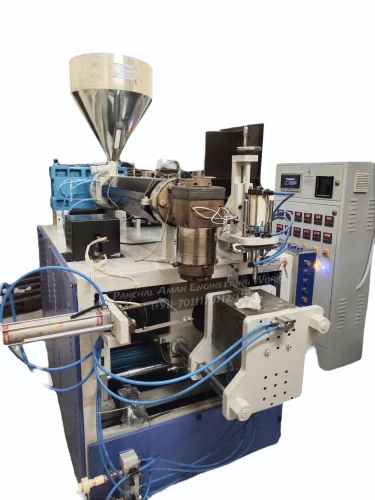
A plastic blow moulding machine makes hollow parts by inflating hot plastic inside a mould. The plastic may be HDPE, PP, PVC or PET, and the machine family changes with that choice. Extrusion blow moulding starts from granules. Injection blow and stretch blow start from a moulded preform or a moulded parison. Picking the machine means picking the process that suits the polymer and the neck you need.
This article stays with machine types and materials. HDPE selection in more detail is on the HDPE blow moulding machine page. The three processes are unpacked in the blow moulding machine guide.
It is the equipment that melts or reheats a thermoplastic, forms a hollow shape, and cools that shape in a metal mould. The mould gives the volume, the neck and the label panels. The machine gives the melt, the air, the clamp force and the cycle. Without a mould matched to the machine, the machine cannot make your bottle.
An extruder and die form a parison. The mould closes on it and air inflates the part. This is the usual route for HDPE and PP containers, jerry cans and many industrial packs. Continuous parison machines suit a steady stream of lighter bottles. Accumulator machines suit a heavier shot. Both appear on Panchal’s product list.
A preform is injection moulded, then blown. Necks are often very consistent because the neck is moulded, not pinched from a tube. It is a different machine from an extrusion line. Do not assume an extrusion builder’s clamp can be converted to injection blow.
A PET preform is heated, stretched and blown. That is how most clear beverage bottles are made. Panchal lists Pet Moulds for this family of tooling. The machine that blows the preform is not the same as the extruder series used for HDPE cans.
On an extrusion machine the cycle is melt, parison drop, mould close, blow, cool, open and deflash. Wall thickness is set by how the parison is programmed and by how the mould cools. On stretch blow, the cycle is heat the preform, stretch with a rod, blow, and cool. Mixing those steps up is the most common way to specify the wrong machine.
If the cycle should run with less handling, read automatic blow moulding machine. Automation does not change the polymer. It changes how the clamp, deflash and take-out are sequenced.
A machine set for one resin is not automatically ready for another. Screw design, temperatures and the head all have to suit the melt. Say which polymer you will run when you enquire. Panchal’s Multi Layer Series is the listing to open when the bottle is not a single material.
Bottles, jars, jerry cans, drums, ducts and some technical hollow parts. Household cleaners, lubricants, personal-care bottles and plain industrial containers are everyday extrusion-blow products. Clear water and beverage bottles are usually PET stretch-blow products. The mould catalogue for extrusion packs is under Blow Moulds.
Packaging converters, in-house filling plants and custom moulders all run plastic blow moulding machines. The industrial question is usually layer structure and container weight, not a brand of cap. A plant packing solvents may need a different HDPE grade and a different head from a plant packing a light cosmetic bottle. Bring the filled product into the conversation, because stress cracking and wall thickness follow from what goes inside.
The full published list is on the product page. A Delhi NCR overview of plastic moulding equipment is also at plastic moulding machine dealer in Delhi NCR.
Panchal – Aman Engineering Works lists extrusion blow moulding machines, continuous and accumulator parison series, multi-layer and colour-head machines, custom machines, blow moulds and PET moulds. Tell the team the polymer and the container. They can say which of those listings is the relevant one, instead of treating every plastic bottle as the same machine.
Commonly HDPE, PP, PVC and PET, but not all on one machine. PET stretch blow uses a preform. HDPE and PP jerry cans are usually extrusion blow moulded.
Blow moulding makes hollow parts by inflating a parison or preform. Injection moulding fills a closed mould with melt to make solid or open parts such as caps and crates. The machines are not substitutes.
Yes, by changing moulds, as long as the head, the shot and the clamp still suit each mould.
When the container needs more than one material in the wall, such as a coloured outer layer or a structure you have already specified. A plain single-layer bottle does not need it.
Treat them as a separate item unless a quotation says otherwise. Blow moulds and PET moulds are listed on their own.
The site lists several extrusion series plus PET moulds. The right listing depends on the resin and the process, so mention both in the enquiry.
Send the bottle drawing or sample, the plastic name, and whether you need one layer or more. Use the contact form, phone or WhatsApp.
Share the resin and a sample. Ask which series on the product list is the right place to look.
Send an enquiry WhatsApp
Founded by Mukesh Kumar PANCHAL AMAN ENGINEERING WORKS has established itself as a trusted name in the field of Plastic Blow Extrusion Automatic Moulding and Blow Moulds, Pet Moulds, Roto Moulds, Injection Moulds.


Panchal - The Leading Machinery Works Company . All rights reserved.
Founded by Mukesh Kumar PANCHAL AMAN ENGINEERING WORKS has established itself as a trusted name in the field of Plastic Blow Extrusion Automatic Moulding and IBM Machines.