



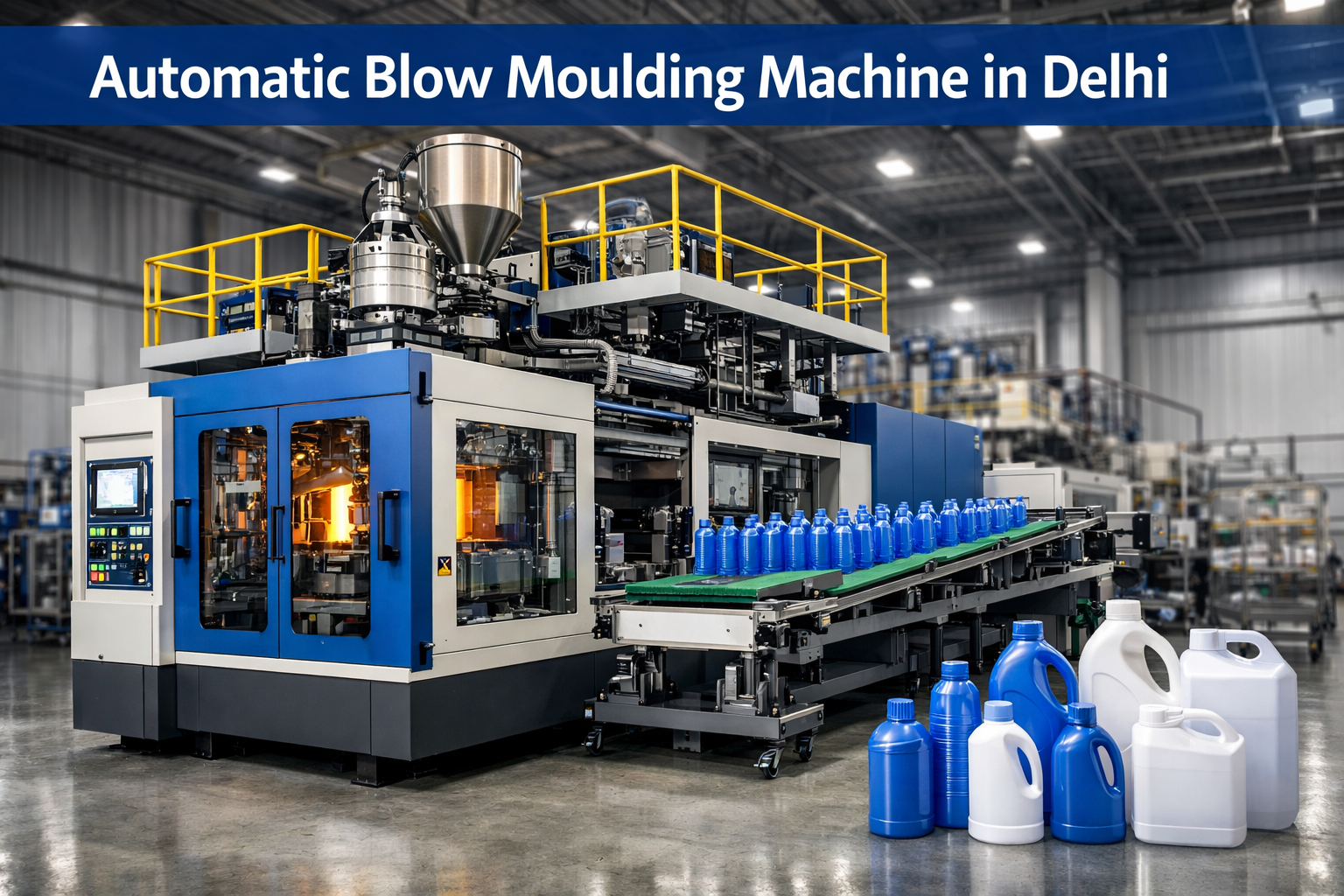
An automatic blow moulding machine repeats the blow moulding cycle under its own sequence. The operator sets temperatures, timers and the parison programme, then the clamp, blow air, cooling and take-out follow that sequence. The word “automatic” does not name a single model. It describes how much of the cycle is left to the machine instead of to hand tools between shots.
Panchal lists an Auto-deflashing Series for lines where flash is removed as part of the cycle. The city page automatic blow moulding machine in Delhi covers the same topic for local buyers.
It is a blow moulding machine whose main motions are driven and timed by the control system. A manual or semi-automatic setup may still need a person to close a mould, cut flash or lift the bottle. An automatic cycle links those steps so the next parison starts when the previous part has left the mould. Someone still supervises temperatures, material feed and quality. Automation reduces handling. It does not remove the need for a setter.
On an extrusion machine the control watches the parison, closes the mould, blows, holds for cooling, opens, and hands the part to a take-out or a deflash station. Timers and limit switches or sensors keep the order. If one step is late, the sequence should stop rather than close the mould on a part that is still inside. That interlock is worth asking about when you compare panels.
Stretch-blow automation is a different sequence: preforms are heated, then stretched and blown, often on a separate machine. Confirm which process you need before you compare “automatic” machines only by the look of the cabinet. The process differences are in the blow moulding machine guide.
A conveyor or a packing table may sit after the machine. Those are part of the line, and they should be named in the scope if you expect them. Do not assume a photograph that shows a long conveyor is the machine you will be quoted.
The practical gains are a repeatable cycle, less time spent trimming by hand, and a clearer job for the operator: watch the process instead of lifting every bottle. Flash trimmed in a fixture is more consistent than flash torn off with a knife. Changeovers are still real work. A new mould, a new neck or a new resin still needs setup even when the cycle itself is automatic.
Automatic equipment also has more to maintain: sensors, valves and the take-out. Ask who supports that hardware. Panchal publishes a technical support number, +91-9643604027, alongside the sales lines.
Cycle time is the sum of parison formation, blow and cooling, not a single catalogue number. A thick HDPE can will not cycle like a thin bottle. If you run several moulds, ask how long a mould change takes on the series you are shown, and whether deflashing tooling has to change with the bottle. Material handling, a hopper loader and the space around the clamp matter as much as the panel.
For HDPE-specific choices, including accumulator versus continuous parison, use the HDPE blow moulding machine article and then decide how much of that cycle should be automatic.
Automatic extrusion lines are used for bottles, jerry cans and other HDPE or PP packs where the same mould runs for a shift. Plants that change bottles often may still want automatic clamp and blow, with deflashing chosen only where the volume justifies the extra tooling. Contract packers and in-house filling lines are both typical users. The container list itself is the same family described on the plastic blow moulding machine page.
Panchal’s product page is the place to see the auto-deflashing series next to the other extrusion series. A custom layout is listed under Customized Blow Moulding Machine.
Panchal – Aman Engineering Works in Delhi can talk through how automatic you need the cycle to be. Start with the bottle and the steps you want taken off the operator. The company overview is on Panchal Blow Moulding.
The clamp, blow, cooling and usually the take-out run in a timed sequence. An operator still sets the process and watches quality.
Deflashing is one station. A machine can cycle the clamp and blow automatically and still leave flash to be trimmed later. Panchal lists auto-deflashing as its own series so that choice is visible.
Not by itself. Cooling and wall thickness still set much of the cycle. Automation mainly removes waiting and handling between those steps.
No. PET stretch blow and HDPE extrusion blow are different processes. Choose the process first.
The bottle, the resin, the steps you want automated, and whether flash must leave the part before it reaches packing.
Ask at quotation time. Published contacts are +91 7011170110, +91 7011170112 and technical support +91-9643604027.
See automatic blow moulding machine in Delhi, linked from this article, for the local version.
Say which steps are still manual. Ask whether auto-deflashing belongs in the scope.
Send an enquiry WhatsApp
Founded by Mukesh Kumar PANCHAL AMAN ENGINEERING WORKS has established itself as a trusted name in the field of Plastic Blow Extrusion Automatic Moulding and Blow Moulds, Pet Moulds, Roto Moulds, Injection Moulds.


Panchal - The Leading Machinery Works Company . All rights reserved.
Founded by Mukesh Kumar PANCHAL AMAN ENGINEERING WORKS has established itself as a trusted name in the field of Plastic Blow Extrusion Automatic Moulding and IBM Machines.