


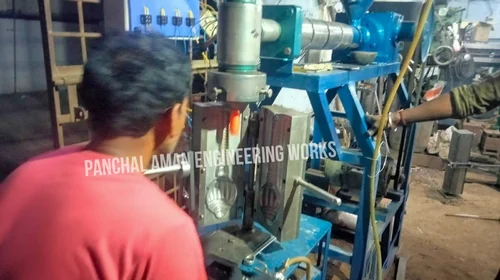
An HDPE blow moulding machine turns high-density polyethylene into hollow packs: bottles, jerry cans, drums and similar containers. The polymer is melted, formed into a parison, trapped in a mould and inflated with air. Buyers usually start with the container, not the catalogue page. Volume, neck, wall thickness and the product that will sit inside the bottle decide the extruder, the head and the clamp.
Panchal – Aman Engineering Works builds blow moulding machinery in Delhi. If the job is HDPE, share a sample or a drawing and the team can point you to a continuous parison, accumulator or related setup listed on this site.
It is an extrusion blow moulding machine set up to process HDPE. The extruder melts the resin. A die head shapes a molten tube, the parison. A mould closes on that tube, a blow pin admits air, and the plastic takes the cavity shape. After cooling, the mould opens and the part is removed. Flash at the neck and base is trimmed, either on the machine or at a later station.
HDPE is chosen because it is stiff, resists many household and industrial chemicals, and can be made opaque or tinted. It is a different route from PET stretch blow moulding, which starts from a preform. If you are comparing both, the blow moulding machine guide separates the three main processes.
Dried or free-flowing HDPE granules enter the hopper. The screw melts and pumps the melt toward the head. On a continuous parison machine the tube keeps extruding. On an accumulator head, melt is stored and then pushed out in one shot, which is the usual approach for heavier jerry cans and larger containers where a continuous tube would sag.
The mould halves close and pinch the parison. Air pressure expands it against the cooled cavity. Cooling time is part of the cycle: a thick jerry-can wall needs longer than a small bottle. The part is then ejected. Neck calibration and the pinch-off at the base are what keep the finish usable for a cap and the base strong enough for the fill.
When you compare HDPE machines, these are the parts that change the bottle you can make:
A double or triple colour head is a separate discussion from a plain single-layer HDPE bottle. Panchal lists a Double/tripple Colour – Head Series and a Multi Layer Series for those jobs.
Typical parts from an HDPE blow moulding machine include small bottles, 1 litre to 5 litre jerry cans, open-mouth jars, lubricant packs and larger drums. The same polymer family covers household cleaners, edible oil, agrochemicals, adhesives and plain water-storage cans. The mould, not the brand name of the machine, fixes the shape. Blow moulds are listed separately under Blow Moulds.
Packaging plants, lube-oil fillers, chemical packers and contract blow moulders are the usual buyers. A plant that already fills HDPE often needs a machine matched to one family of necks so existing caps still fit. A new pack needs the mould and the machine discussed together. For a Delhi-focused page on the same topic, see HDPE blow moulding machine in Delhi.
Output figures depend on the bottle and the cooling. Treat any cycle time as something to confirm on your own part, not as a number copied from a different container.
The published range includes Continues Parison Series, Accumulator Parison Series, Extruder Blow Moulding and Auto-deflashing Series. A custom build is listed as Customized Blow Moulding Machine. Start from the container and ask which of those families is the closer match. The wider company overview is on Panchal Blow Moulding.
Hollow HDPE packs: bottles, jerry cans, jars and drums. The mould and the shot weight decide the exact size.
No. HDPE extrusion blow moulding starts from granules and a parison. PET stretch blow moulding starts from a preform. The machines and the moulds are not interchangeable.
When the parison is heavy enough to sag if it is extruded slowly. Larger cans and drums are the usual reason to look at an accumulator series.
Often yes, if the moulds share the clamp and the head can make the required shot. A change of mould is still a setup, not an instant swap.
Not for a single-layer bottle. Multi-layer and colour-head machines are for packs that need extra layers or coloured stripes.
A sample or drawing, the resin, the neck or cap, and whether you already have a mould. Photos of the current bottle are enough to start.
The product page lists the series. For a wider view of plastic machines, read plastic blow moulding machine.
Call +91 7011170110 or +91 7011170112, WhatsApp +91 7011170112, or email panchalcnc180@gmail.com. Technical support is listed as +91-9643604027.
Send the container details and ask which machine family fits. The team can reply from the Delhi workshop.
Send an enquiry WhatsApp
Founded by Mukesh Kumar PANCHAL AMAN ENGINEERING WORKS has established itself as a trusted name in the field of Plastic Blow Extrusion Automatic Moulding and Blow Moulds, Pet Moulds, Roto Moulds, Injection Moulds.


Panchal - The Leading Machinery Works Company . All rights reserved.
Founded by Mukesh Kumar PANCHAL AMAN ENGINEERING WORKS has established itself as a trusted name in the field of Plastic Blow Extrusion Automatic Moulding and IBM Machines.